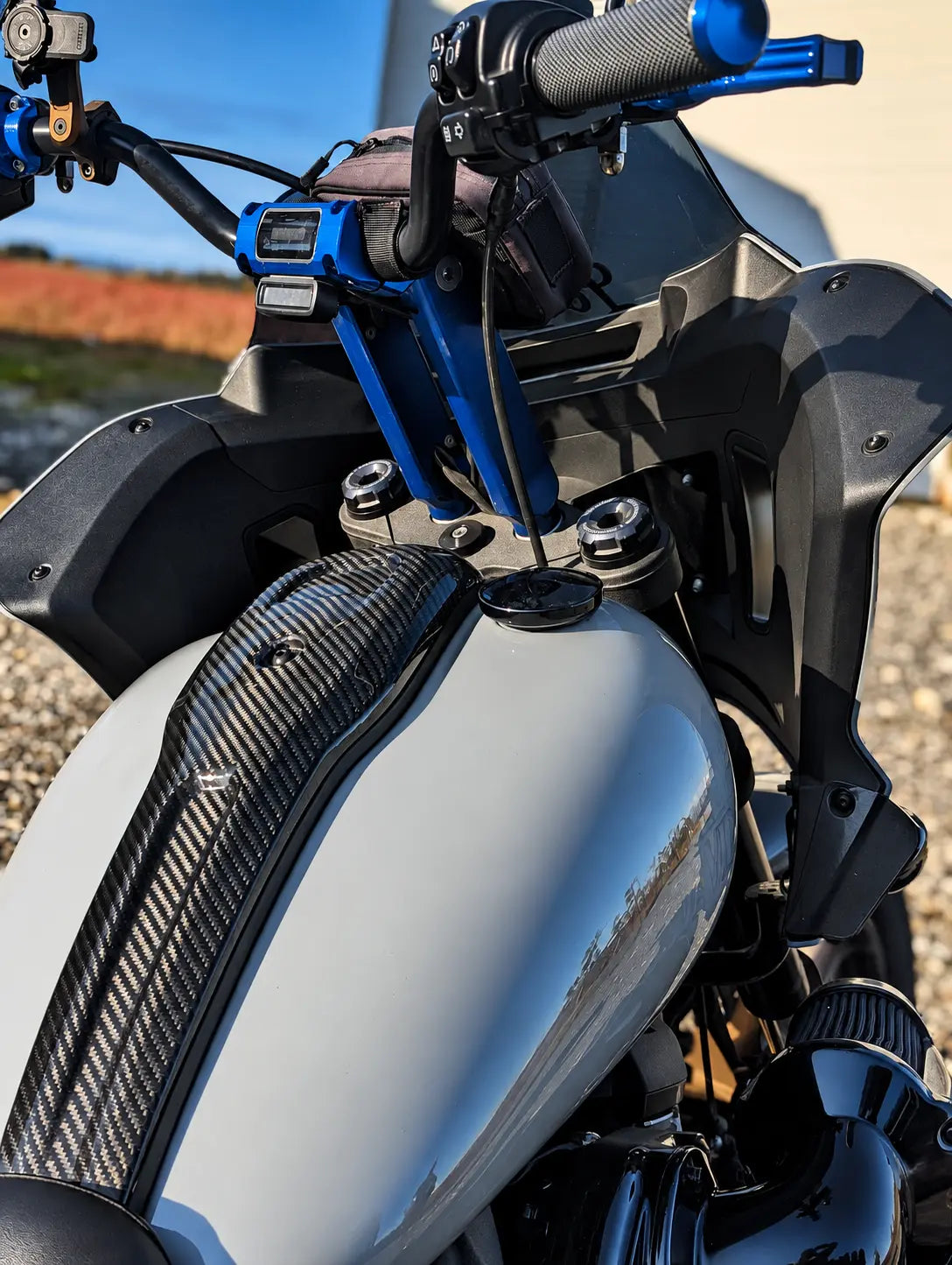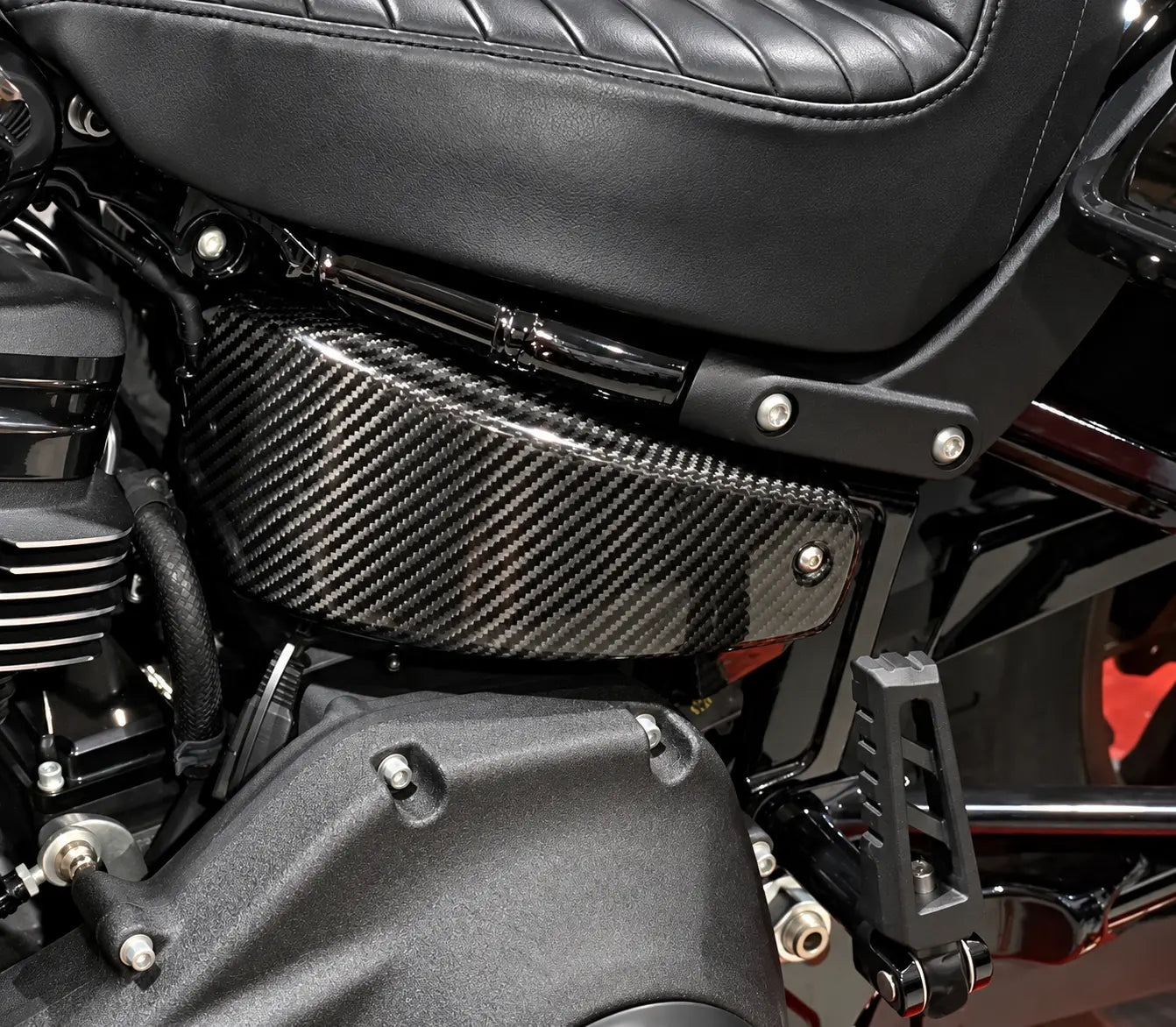
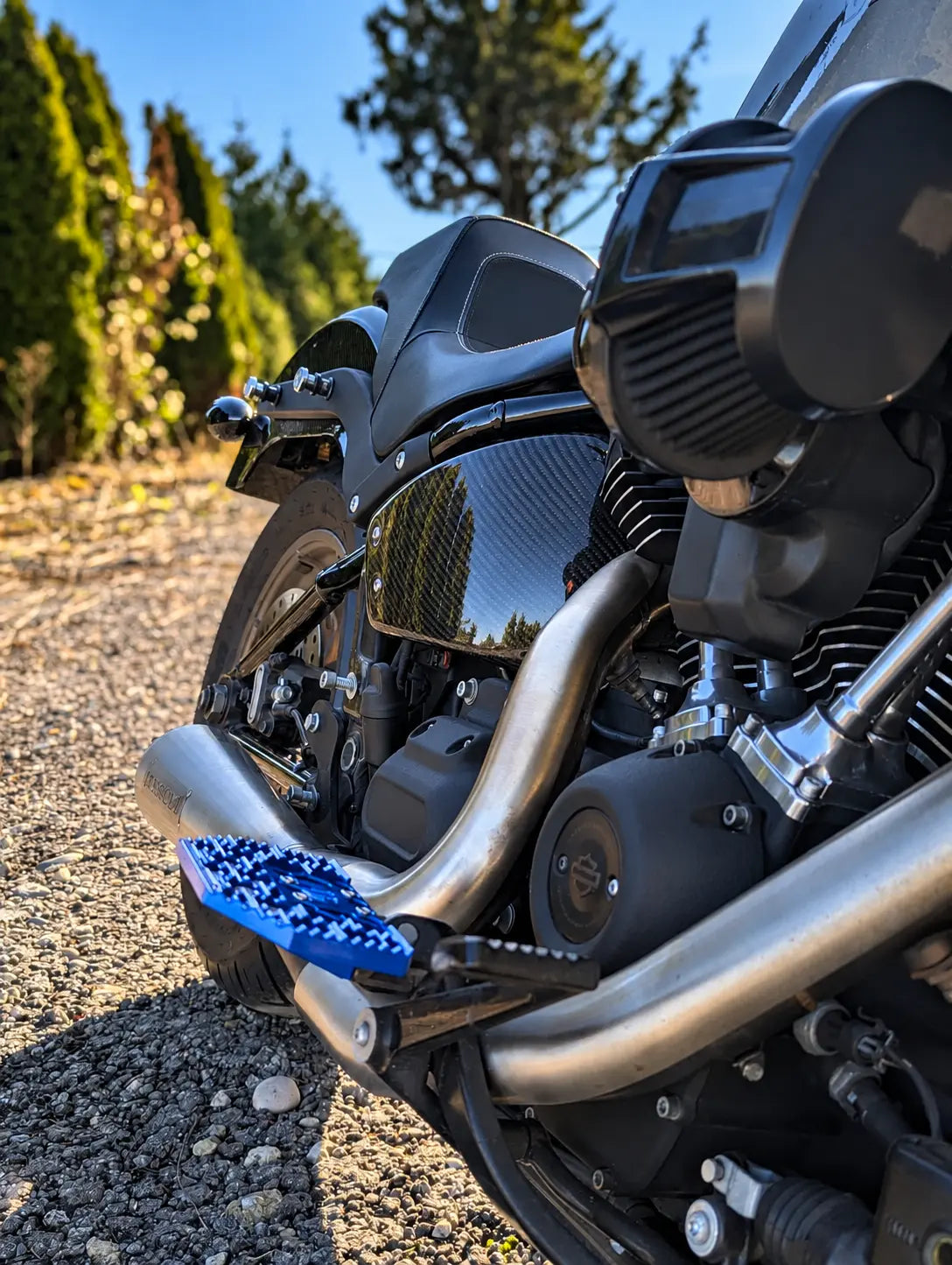
What you see in twill
Twill is the diagonal pattern most riders associate with exposed carbon fibre. In a common 2×2 twill fabric, each bundle passes over two crossing bundles and under two; the sequence steps across the cloth to create diagonal ribs. From a distance it may read as a dark, finely textured surface. Move closer and the repeating direction becomes much clearer.
The diagonal is part of its appeal on a motorcycle. It can follow the visual movement of a fender or introduce a directional detail along the tank. The apparent size of that pattern matters: a small sample may look subtle, while the same repeat across a broad curved panel becomes a more noticeable feature.
What honeycomb means visually
A honeycomb-style surface has a more geometric, cell-like repeat. Depending on the actual material and finish, the cells can look outlined, faceted or almost three-dimensional as reflections move over them. Compared with a diagonal twill, that repeat can become a more prominent design feature, particularly beside simple paintwork.
“Honeycomb” is not a complete material specification. In a product description it may identify the visible pattern. In composite engineering, a honeycomb core is a separate cellular material used inside some sandwich structures. Seeing hexagons on the outside does not establish that the part contains such a core. Ask about construction separately if it matters to your purchase.
Pattern and finish are separate choices
Twill versus honeycomb concerns the visible repeat. Gloss versus matte concerns surface sheen. A pattern name alone does not tell you whether a part is glossy, satin or matte, and a finish name does not identify the pattern underneath it. Compare both before deciding that two pieces match.
| Detail | Twill | Honeycomb-style pattern |
|---|---|---|
| Visual repeat | Directional, diagonal ribs | Geometric cells or hexagonal forms |
| Styling question | Does the diagonal complement the panel’s shape? | Does the cell scale suit the size of the panel? |
| Matching check | Weave scale, direction and sheen | Cell design, scale and sheen |
| Construction | Cannot be established from appearance alone | Does not establish a structural honeycomb core |
Why the same part changes in different light
A glossy surface reflects its surroundings. Under direct light, a highlight can wash over part of the pattern and make adjacent areas look much darker. In open shade, the repeat may look flatter and more uniform. Curved panels also present different angles to the light, so a fender can show several apparent shades in one photograph.
Camera exposure, white balance and reflections from sky, concrete or nearby paint add another variable. A bright studio image and a shaded garage image are poor evidence of a mismatch. Request comparable photographs: similar light, similar distance, a close-up and a full view of each component. A short video moving past the part can help reveal how the reflection changes.
Match the motorcycle, not just two swatches
On a Harley-Davidson Low Rider build, consider the front fender, tank centre and area below the seat as connected views. The tank centre cover is close to the rider’s eye; a front fender also has to work from across the street. A pattern you enjoy close up should still make sense in the whole-bike silhouette.
For a coordinated set, compare the actual pieces together wherever possible. Check the diagonal or cell orientation, apparent repeat size, overall colour and sheen. Pattern direction naturally changes as fabric follows a shaped surface; an installed photograph is more useful than expecting every curve to look like a flat sample. If mixing patterns deliberately, separate them with paint or another quiet surface so the contrast feels intentional.
What the pattern cannot prove
A surface photograph cannot establish fibre grade, laminate thickness, resin system, reinforcement schedule, curing process or tested load capacity. Those are separate construction questions. Do not buy a decorative cover on an assumed strength advantage, or infer a weight saving from a pattern name. Choose the appearance you prefer and seek documented specifications for any performance claim that affects your decision.
Questions riders ask
Is honeycomb stronger than twill?
There is no useful blanket answer for finished motorcycle parts from those names alone. Strength depends on the part’s complete construction and intended loading, not simply its visible repeat.
Can I combine twill and honeycomb?
Yes, as a styling choice. Keep the sheen consistent or make the contrast deliberate, then check the result in full-bike photographs. For an understated build, one consistent pattern is usually easier to coordinate.
Continue with gloss versus matte and planning a complete Low Rider build. For background on materials, Easy Composites describes 2×2 twill fabric, while Hexcel explains structural honeycomb cores. These references explain terminology; they are not specifications for Carbon Syndicate products.